
Built in 1868-69 for Marian Deering Noyes
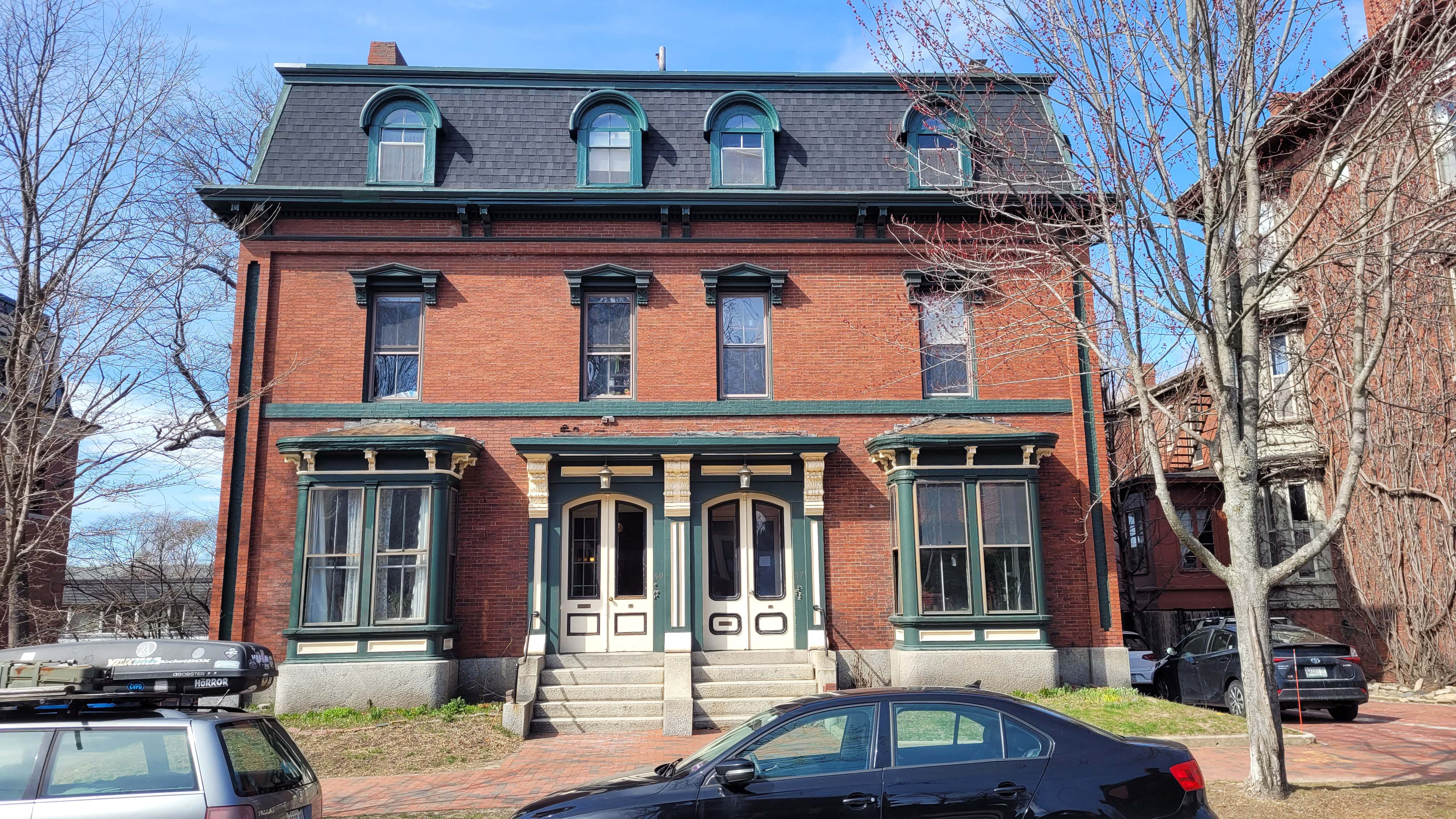
A substantial Second Empire double-house in the Deering Street neighborhood.
Sometimes, the ‘official’ record can lead one astray.
When a reader asked if I would look into 57-59 Deering Street, I looked at the Portland Historic Resources Inventory done in 1976 as I was fairly certain the location was covered. It was and you can see the entry below. All well and good. We have a date, who it was built for, and a new architect for the blog. A great start.

Hold on a minute…
Other than the date, none of this information appears to be accurate. But, we will get back to that.

Although laid out in the 1850’s Deering Street was mostly open ‘pasture’ until the Great Fire of 1866 destroyed much of the old residential blocks in the center of the city. As these areas were rebuilt predominantly as commercial space, the residential areas moved outward to the west and north. During this period, Deering Street would become a fashionable district as we have seen. Our subject is part of this story.

George Noyes and Marion Deering where married in Portland in February of 1857. Both of those names are well known in Portland’s history with Marian being the granddaughter of James Deering for whom Deering Oaks, Deering Street, and Deering Avenue, was named. George was a graduate of Bowdoin College who went west in 1849 and became a successful attorney. He served with distinction in the Civil War and may have been wounded but this is not clear. After the war, George & Marian settled in New York where he was again successful. The couple had 4 children, all boys, between 1858 & 1867. George Freeman Noyes died of ‘bilious colic’ in January of 1868.

Now is the time where we take one part of the entry from the Historic Resources Inventory and see if it holds up. That is the statement the the house was built for “Joseph C Noyes”. Joseph Cobham Noyes was George’s father. He was a prosperous merchant who served in the US House in Maine’s earliest days as a state. Joseph also died in 1868. As far as I can determine, Joseph Noyes never owned any land on Deering Street. He certainly did not own the land under our subject.

Marion Noyes purchased the land for our subject from her father, Nathaniel, and other relatives in late June of 1868. On December 1 of the same year, she took a mortgage from the City of Portland for $5000.00. The note describes 57-59 Deering Street as a “block of 2 houses recently erected by me“. The mortgage was on the right unit or #57.
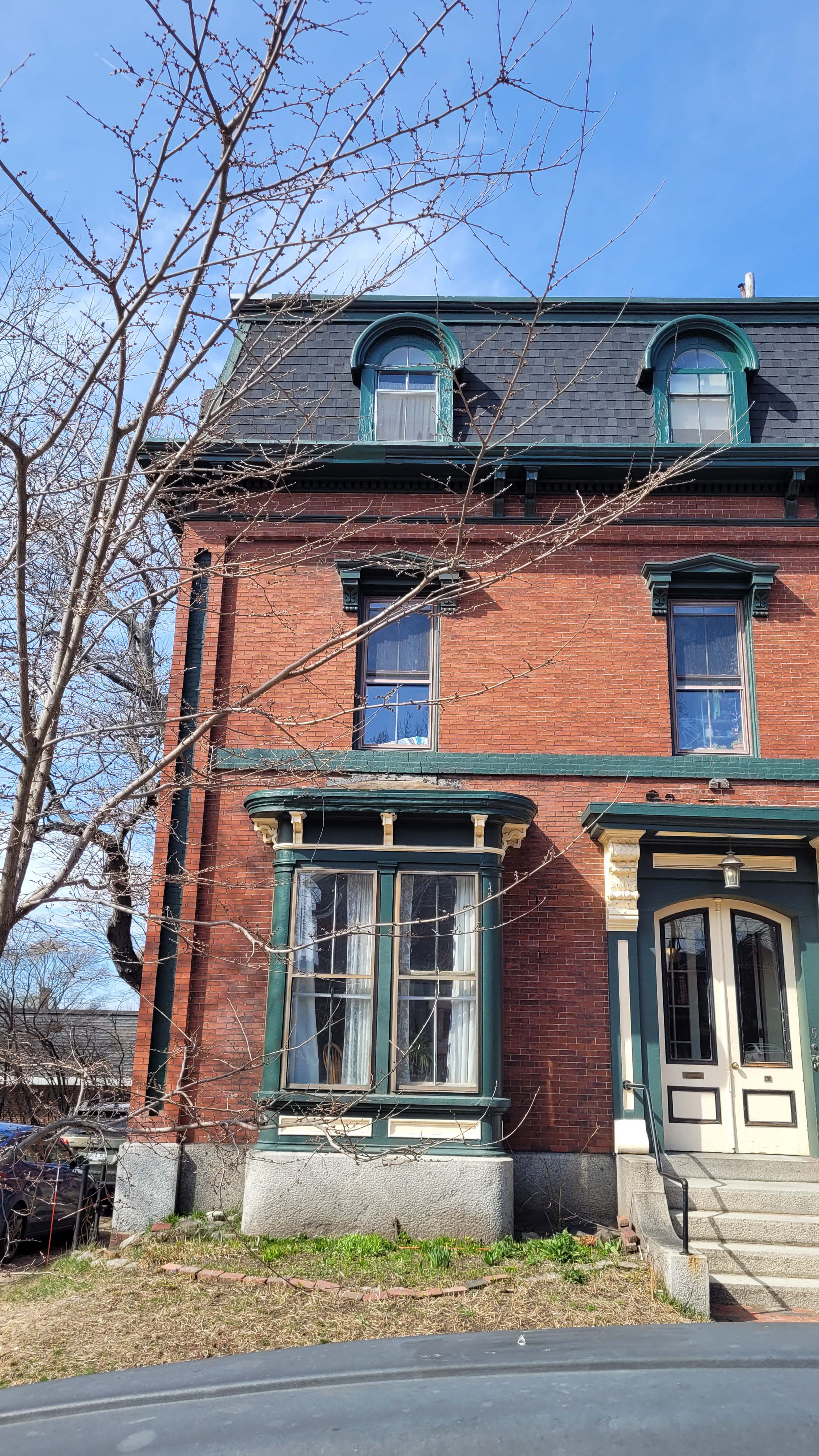
What Marion Noyes had built measures 48′ on the street with the main block being 34′ deep. It is 2 stories with a third in the garret. The second story shows to be particularly tall from the exterior. The rear ells for are unique for each unit. #57’s is 20′ wide and 40 deep. It is a single story with a second in the garret.

The ell for #59 Deering Street is 18′ wide by 60′ deep. It too is a single story with a another in the garret. As this was Marian’s home, I wonder what made her choose a larger but seemingly more cramped arrangement for the ell. Servants perhaps?
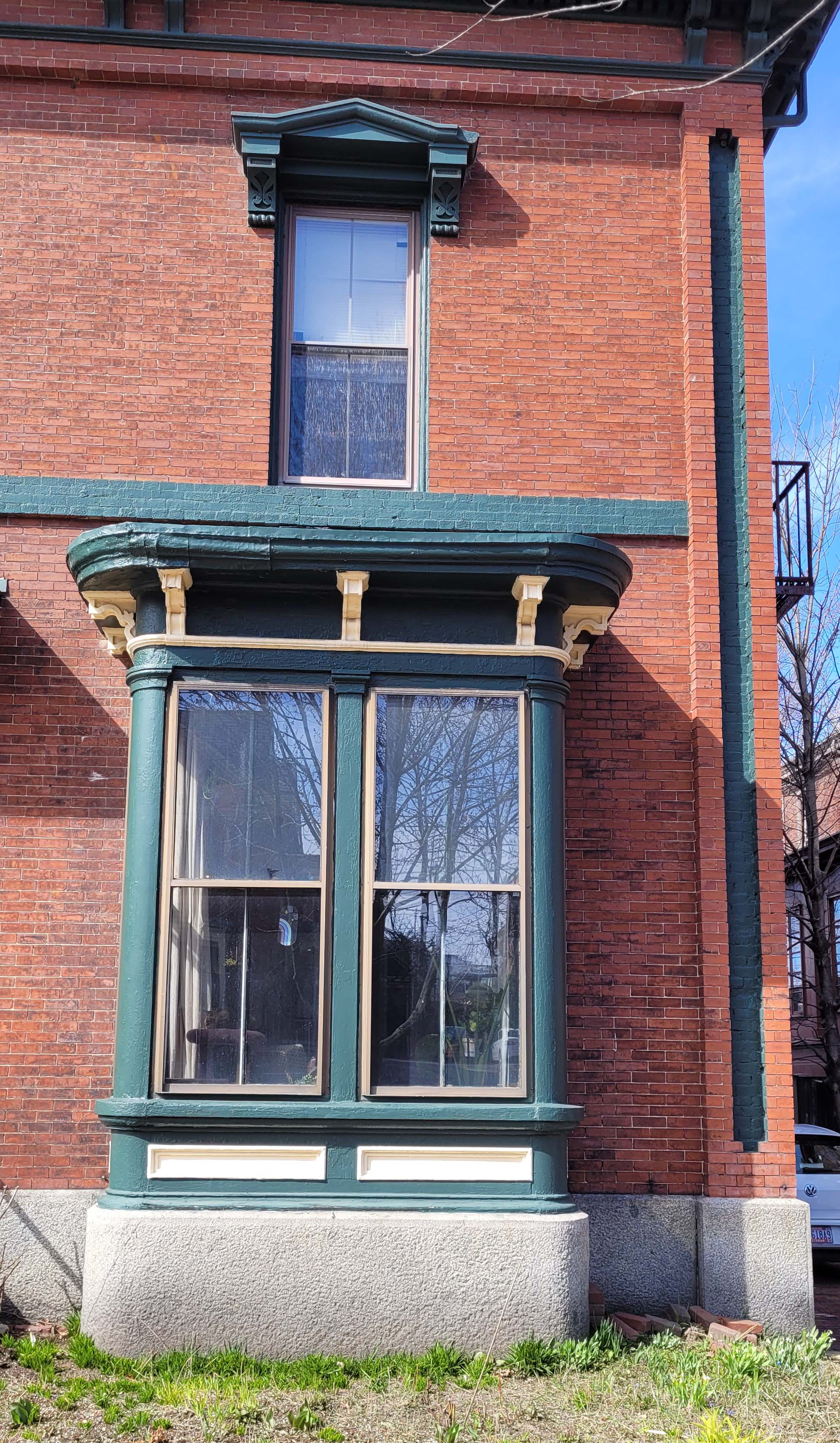
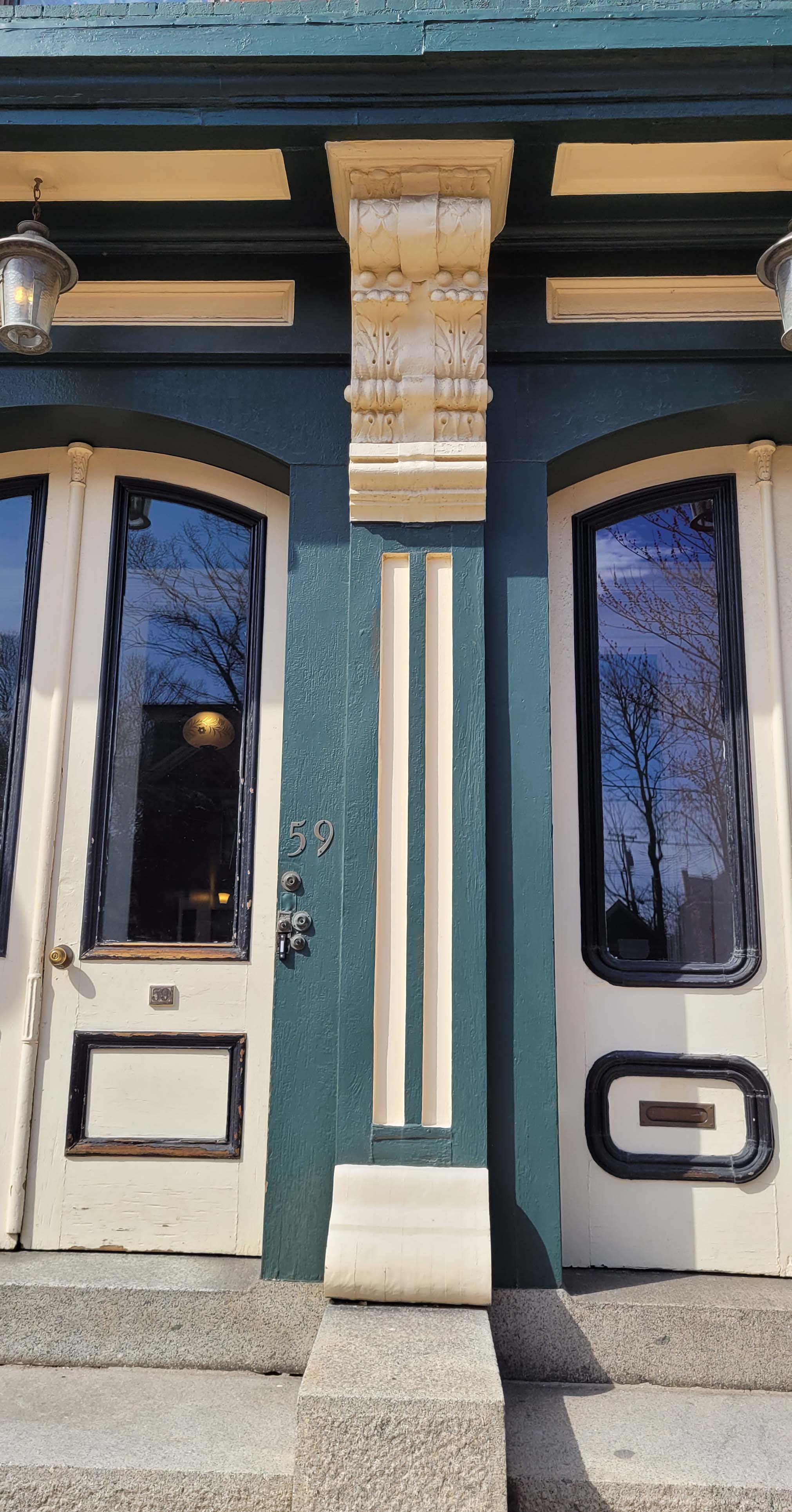
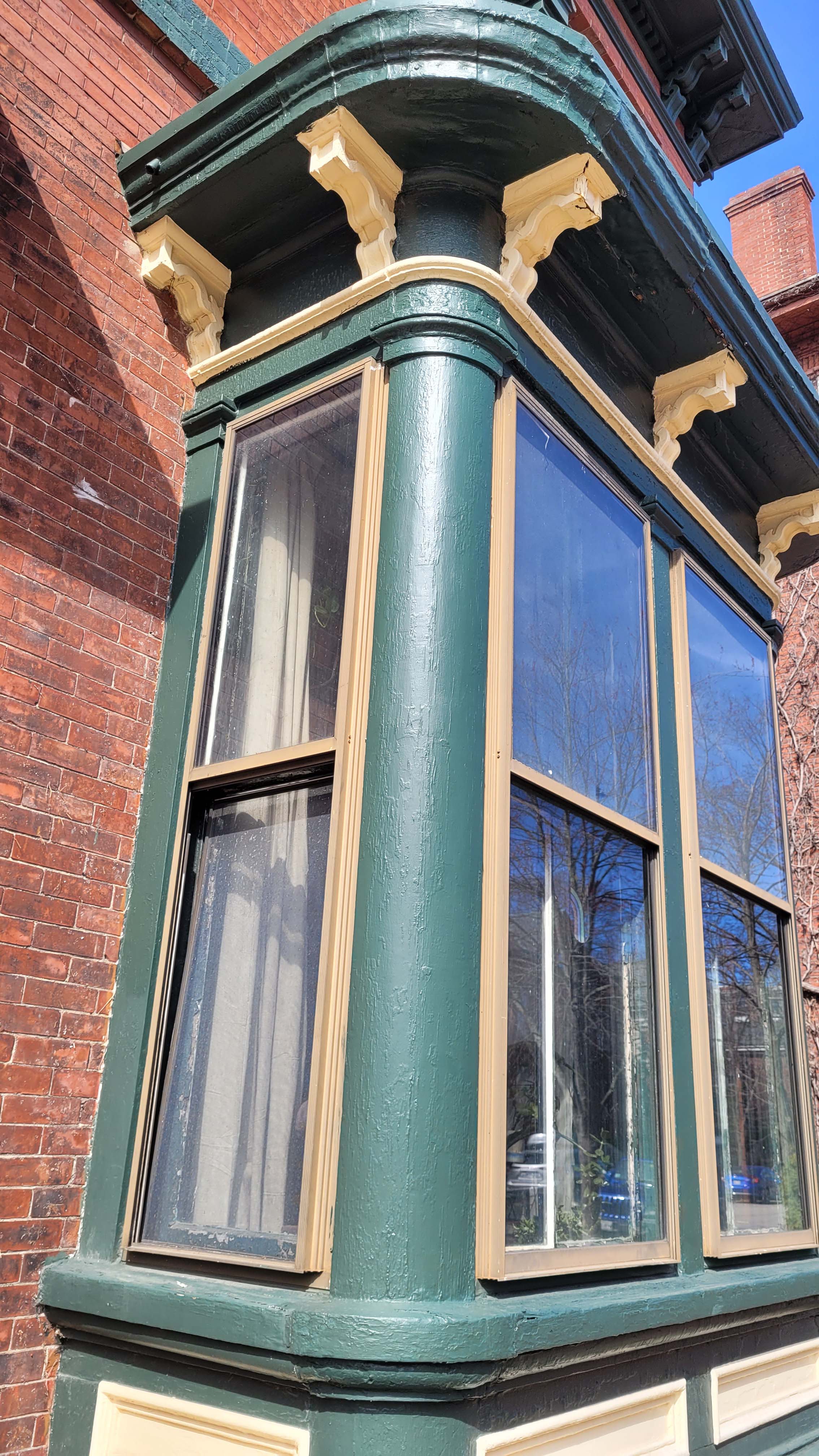
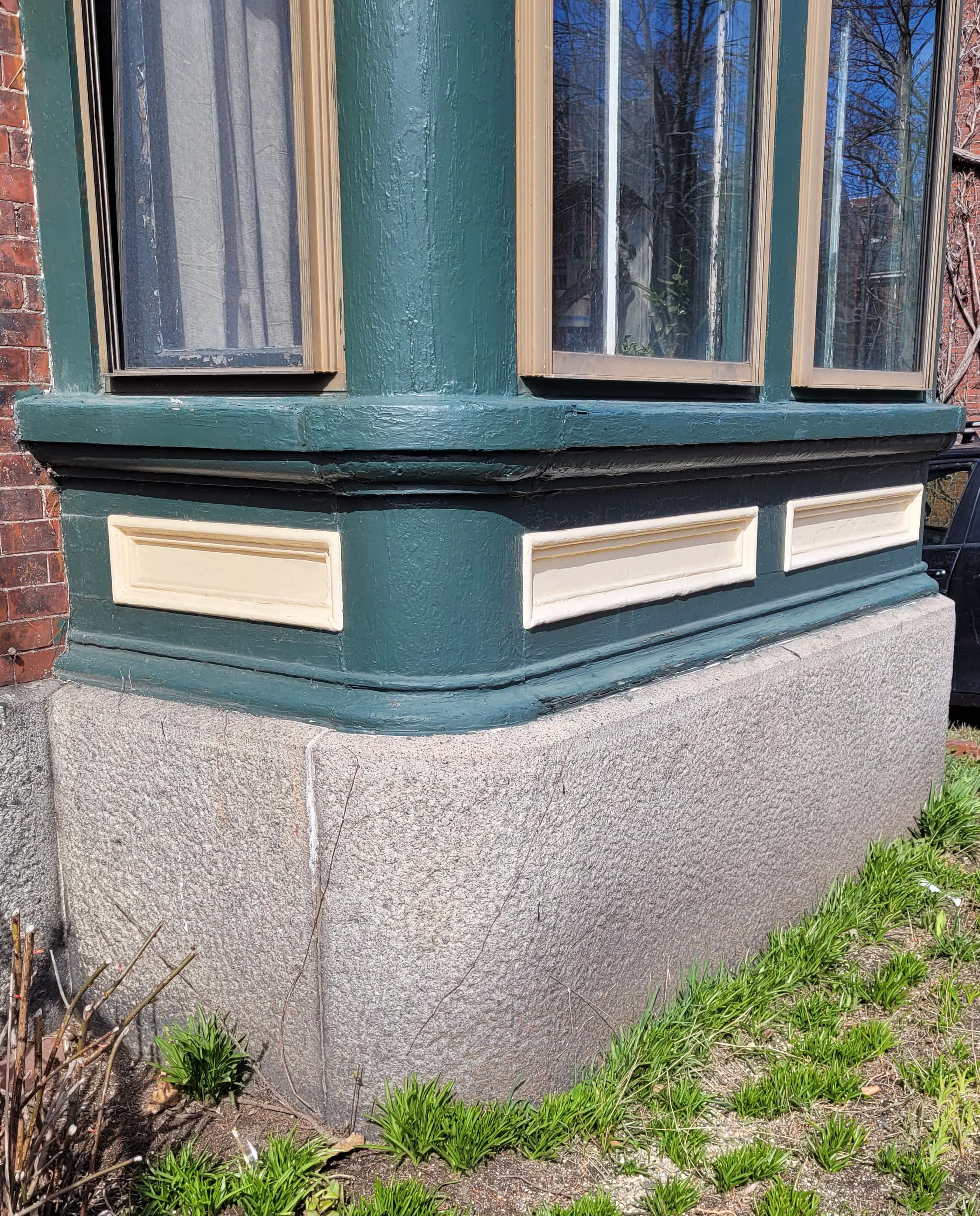
This is a good point to look at the design/style of 57-59 Deering Street and look at the other part of the Portland Historic Resources Inventory. That of Levi P Newcomb as the architect. The extremely heavy beltline, heavy hoods over the second floor windows, and Mansard roof with arched windows is very much Second-Empire. Some elements of the design, such as the portico and bay windows, are quite nice and show a developed hand. Some parts, the afore mentioned beltline and the pilasters, do not seem to fit with the overall scheme. As noted in the Historic District report, much of the masonry and details such as the pilasters and architrave with paired brackets resembles the work of the Chase Brothers 15+ years earlier.
Levi P Newcomb was a Boston based architect. He designed structures of all types all over New England. After the Great Fire, he and his son, Edgar Allen Poe Newcomb (really), opened an office here to take advantage of the need for new buildings. They are credited with a few including:
- The First Baptist Church. Demolished
- North School.
- 85 Exchange Street. The Portland Bank Building. The first floor exterior has been altered.
- The St Julian Hotel which sat at the corner of Middle and Plum Streets. Demolished.
- 267-273 Commercial Street. See image below.
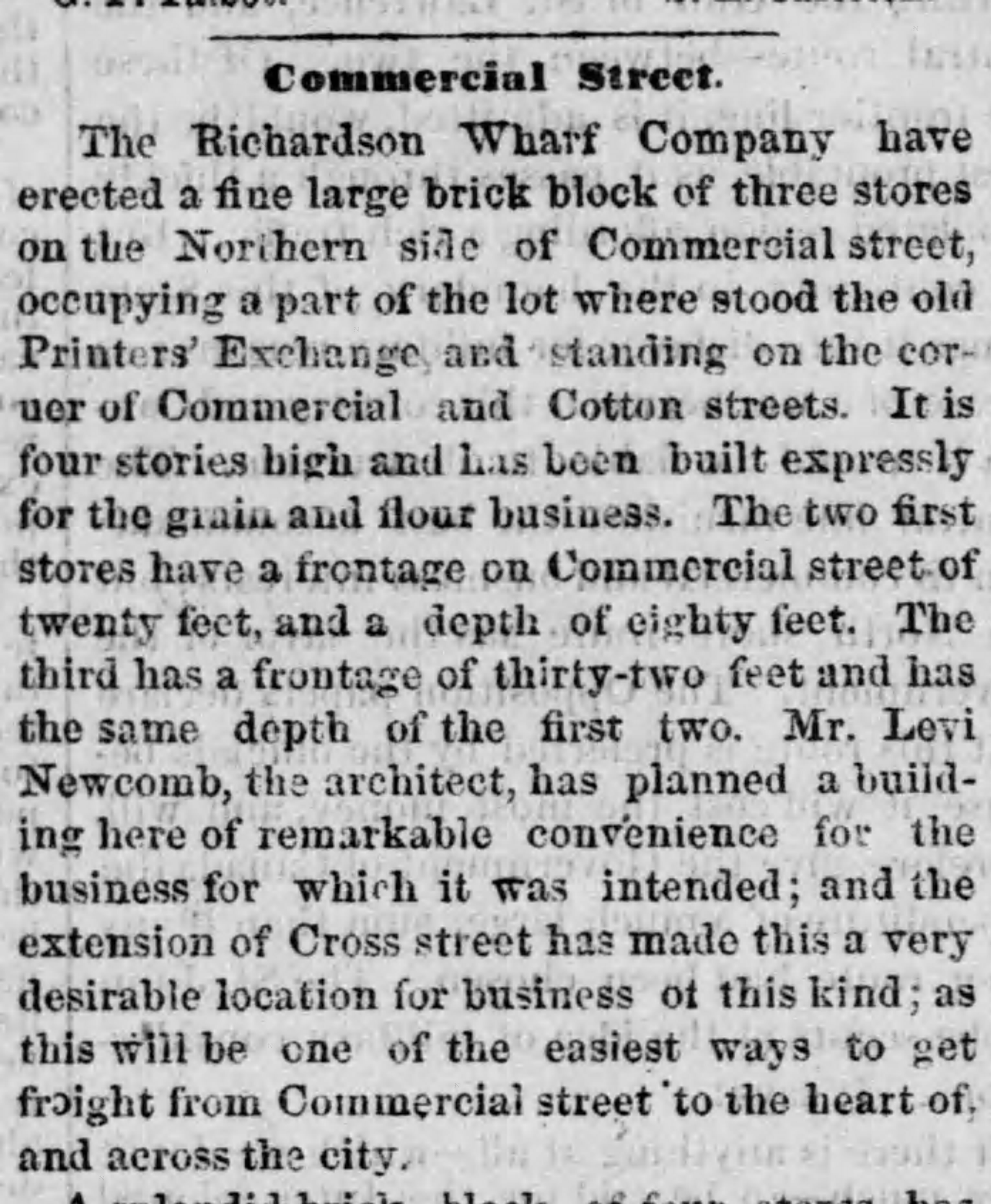
Outside of Portland, there was
- Felton Hall at Harvard
- Memorial Hall at Bowdoin, now the home of the Maine State Music Theater
- The Boston & Lowell Railroad Station where North Station now stands.
- Dormitories at Tufts and Dartmouth.

After all that, here is the issue. I cannot find any evidence to that connects Levi P Newcomb to 57-59 Deering Street or to Marian Noyes for that matter. Having searched all of the archives I can find online, I have drawn a blank. Perhaps she was a member of the First Baptist Church and met him there but there is no evidence of this. Also, I cannot find any residential work by Newcomb which may have given something to compare with. Therefore, accepting the notion of ‘lack of evidence is not evidence of lack’, I have to say I do not think Levi P Newcomb designed our subject.

Marion Noyes sold #57Deering Street to Rufus H Hinkley in April of 1870. What made her wait over a year before selling isn’t recorded but she did not ‘need for money’.
Rufus Hinkley was a native of Gorham where he was born in 1830. He worked as a clerk for Cyrus Clark’s lumber business on Commercial Street for a while in the 1850s. He married Frances Prindle in 1867. Frances grew up in Whitehall NY where she was born in 1843. Their first child, Marion, was born in 1868. By this time, Rufus was working as a book keeper.
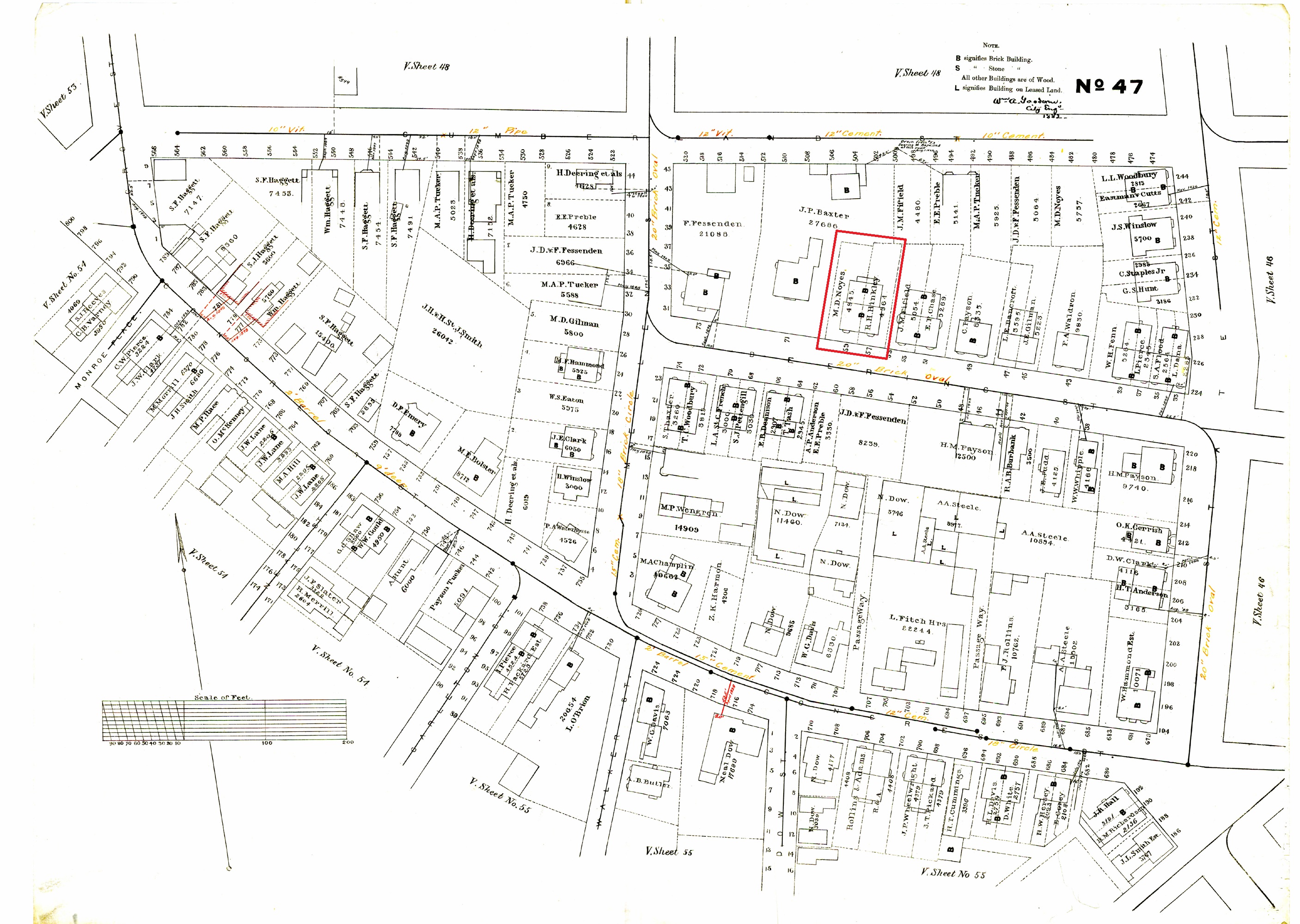
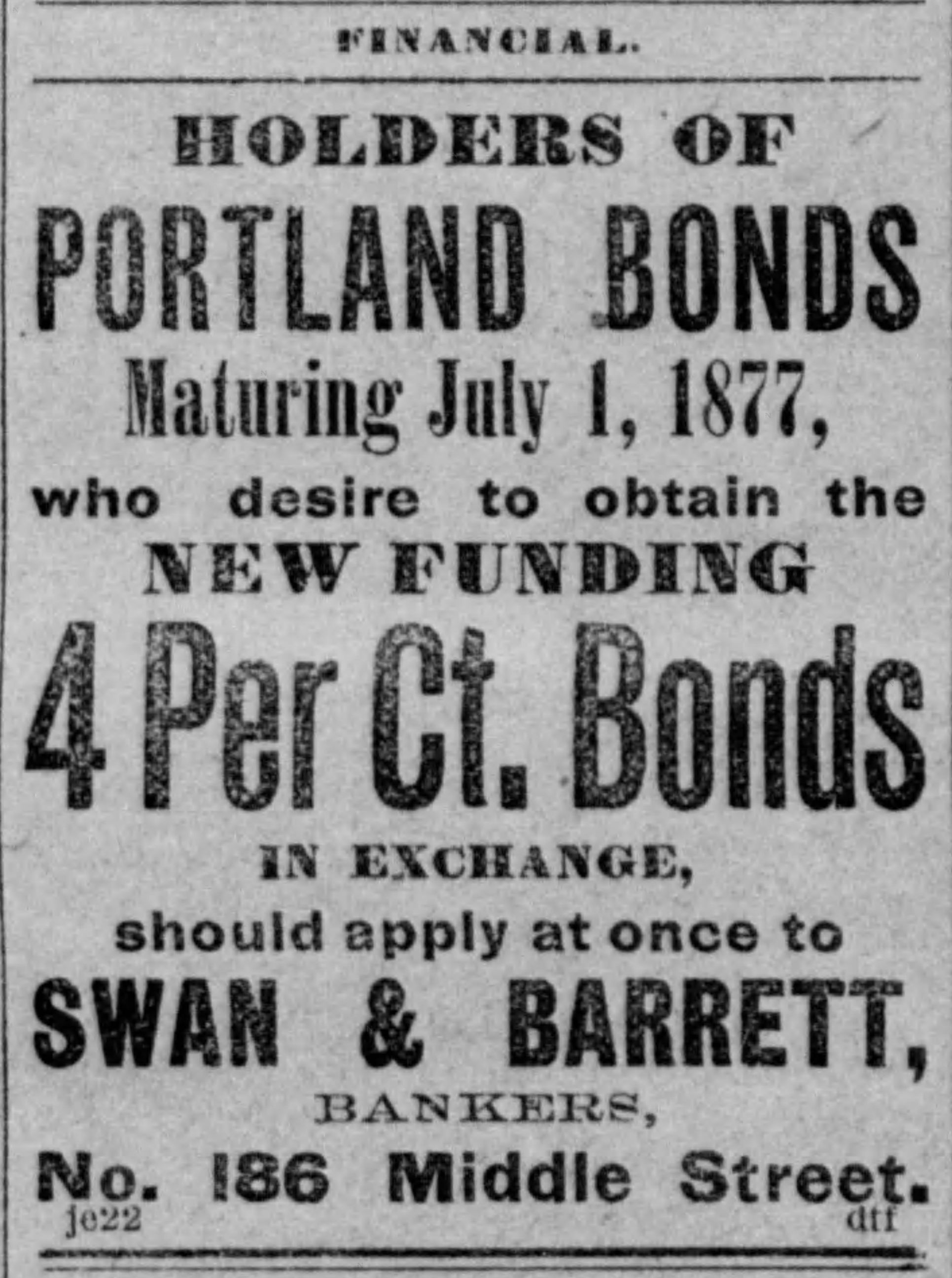
Rufus & Frances Hinkley had 8 more children between 1869 & 1885 including twin girls in 1871. 57 Deering Street must have been full. Rufus seems to have been successful as he gave the value of his personal holdings as $10,000 in 1870. This was the same amount, $10,000, the he and Marion Noyes gave for their respective sides of our subject. The 1882 city directory shows Rufus as a partner and the cashier for Swan & Barrett, a private banking firm on Middle Street.
Marion Noyes lived at 59 Deering with her 4 sons. She doesn’t seem to have been involved in many activities although she did sign a petition against giving women the right to vote that was published in June of 1887. Perhaps the most important event that she was involved with was the creation of Deering Oaks Park. In February of 1879, the heirs of James Deering sent a letter to the city of Portland offering to donate much of the land that now encompasses the park to the city. In return, the city would agree to keep the value of the land between Deering Street and Park Avenue as undeveloped pasture until such time as they start to develop it. To this the city, in time, agreed.

Rufus Hinkley died of heart disease on March 5 of 1900. 3 daughters and a son were living with Rufus and Frances at the time. Frances Hinkley also died of heart disease on Christmas Day of 1908. 57 Deering Street remained vacant until early 1912 when is was sold to Mary J Woods.
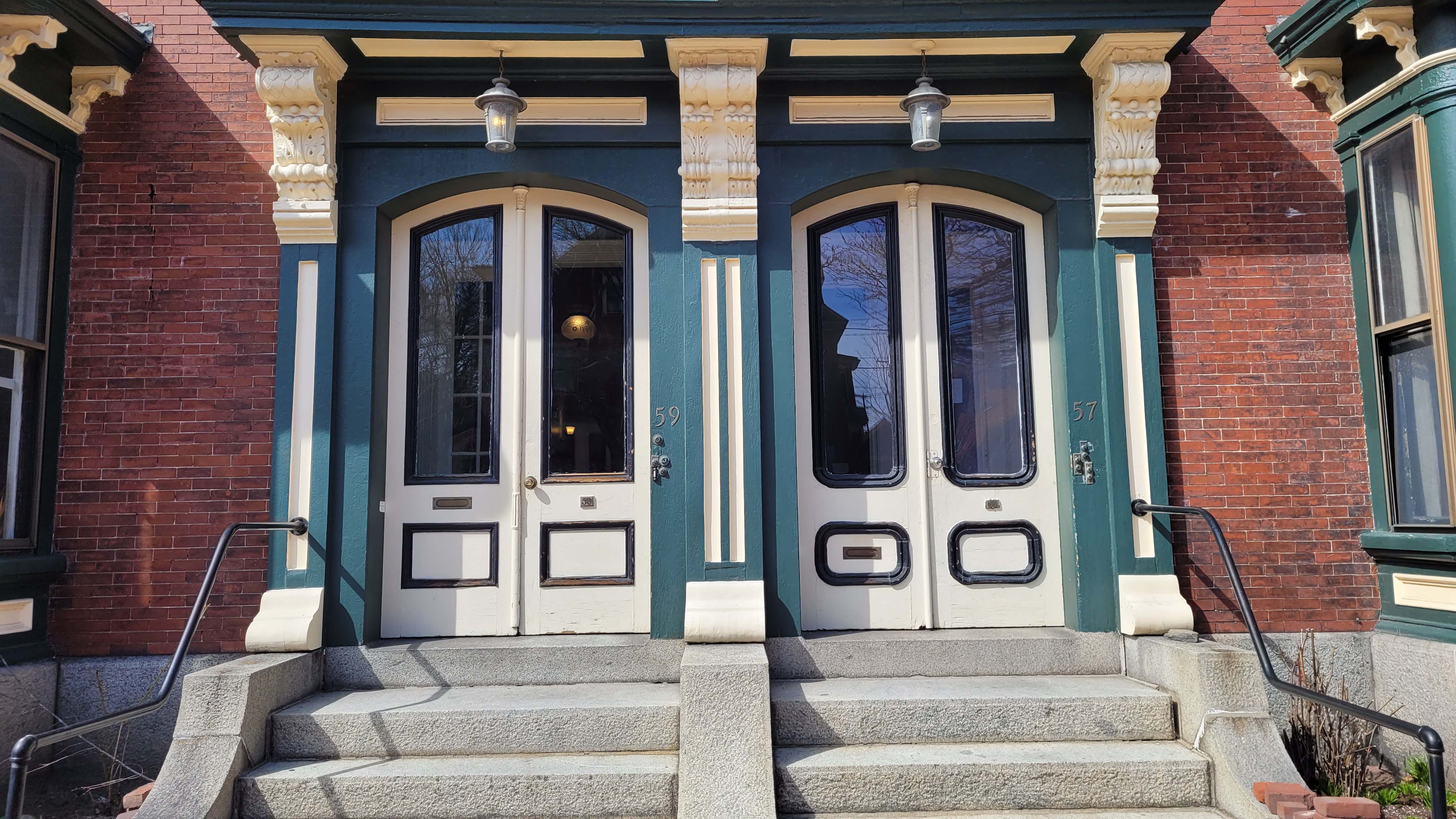
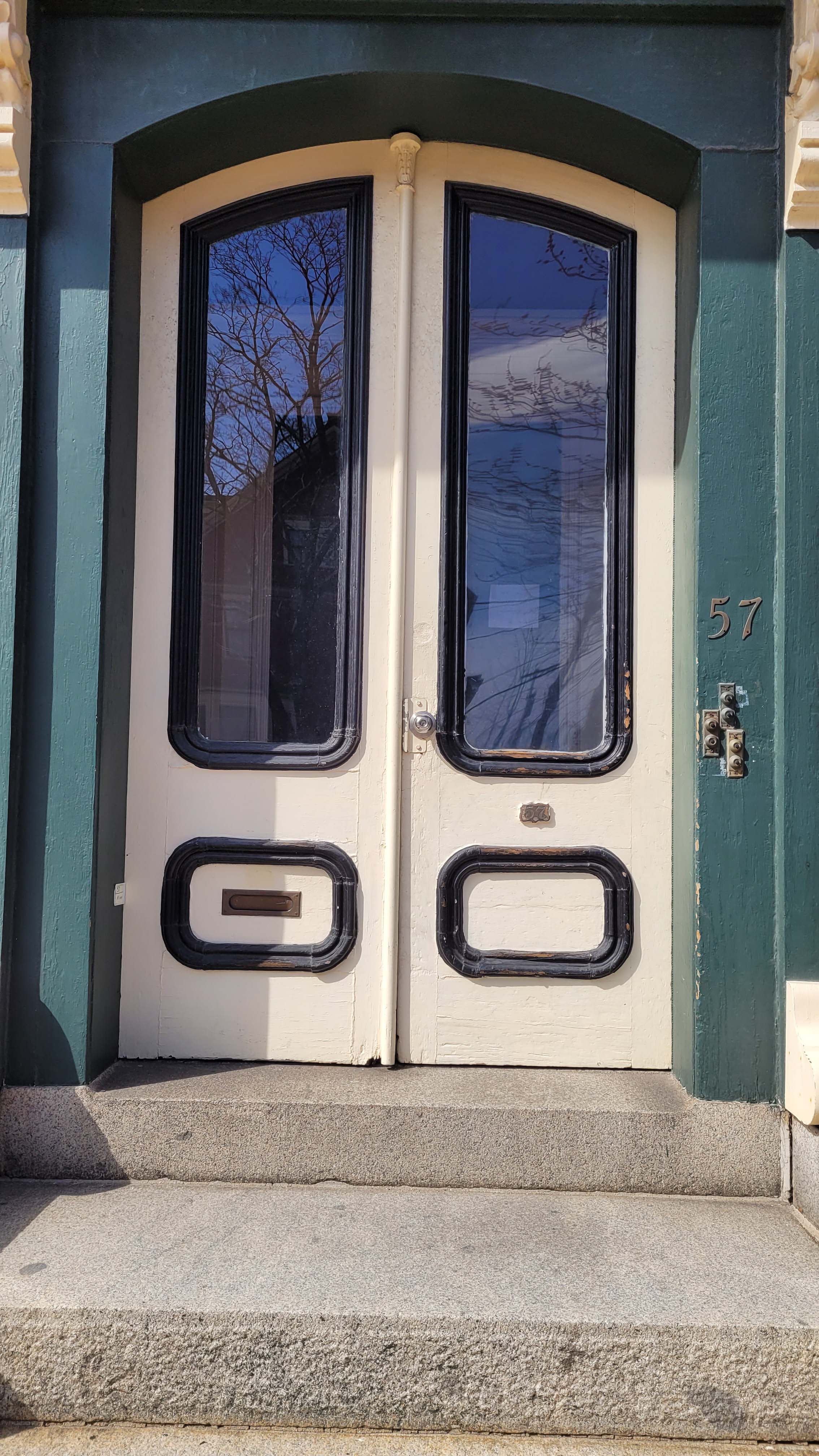
The entry portal is of notable quality. The arch topped doors are unique in that most doors are flat topped with an arched transom above. Here, the larger height and graceful curve are much more commanding of our attention. The brackets are nicely styled but seem too heavy for the hood they support. Oddly, the two entries, although seemingly identical, have different treatments to the panel and window details. 57 has rounded corners while 59 has square. The doors are, I believe, original.

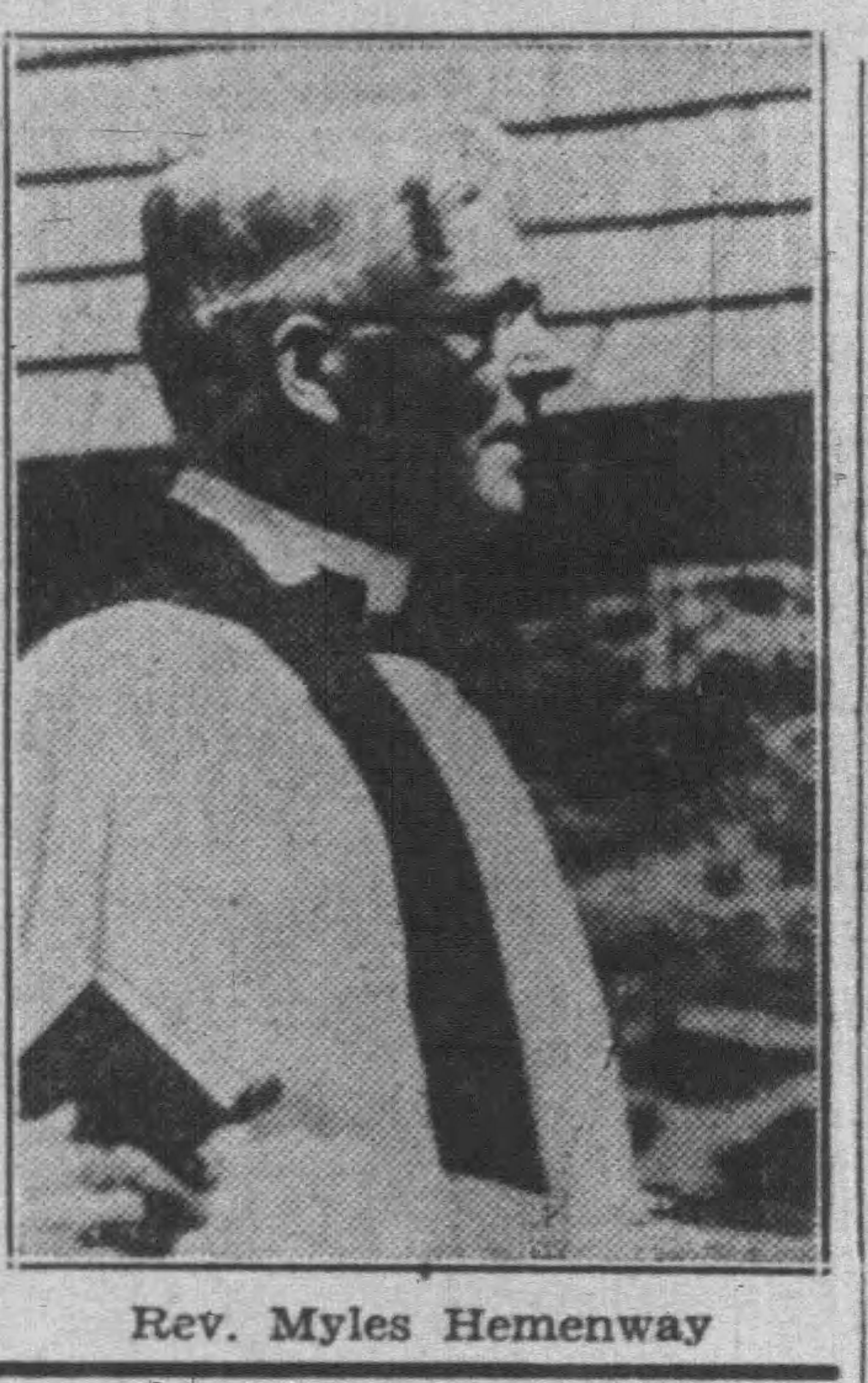
Marion Noyes lived on at 59 Deering Street until her death in 1924. Living here along with her were her son Ilsley, a nurse, and two servants. Her will passed the home to her children. They sold it in September of 1924 to an Episcopalian priest originally from Warren Maine named Myles Standish Hemenway. By that time, 57 Deering had been sold to Marion Messer.

Myles Hemenway was named Canon of St Luke’s Cathedral in early 1924. Before coming to Portland, he had served in Saugus MA, Pittsburg PA and a couple of places in Maine including Seal & Northeast Harbors on Mt Dessert. Prior to that, he ran a dairy farm in Vermont. Along the way he wrote & published a book called ‘Passengers. Doomsday, April’. He was also published in Harpers. Hemenway’s time as Canon was short as, in early 1926, he and other clergy were forced to resign as part of a larger change in focus for the church. After Myles Hemenway died in 1947, his children, he had been twice married, sold 59 Deering Street to Marcia Crockett.
Meanwhile, next door at 57 Deering Street, Mary J Woods had purchased the home from Frances Hinkley’s heirs in 1911. She was born Mary E Jordan in 1877. She married Fred S Woods in South Portland in 1906. Mary was born in 1877 and Fred in 1879. Fred was a dentist with an office on Congress Street where the 7-11 now stands. I do not think the Woods lived here as Fred’s draft registration of September 1918 lists him living above his office on Congress Street. In early 1919, 57 Deering Street was sold to Elva Baldwin.
Elva and Albert Baldwin lived at 57 Deering Street for a little less than 3 years. Albert was, according to the 1920 Census, a physician in ‘general practice’. They had a teenage son, Marshall. In January of 1922, Blanche Campbell purchased the property. 5 months later, Campbell sold it to Marion Stephen Messer. Messer was a resident of South Portland. He sold 57 Deering to Ethel Fickett in 1925. Fickett took a mortgage from the Portland Savings Bank when she purchased it. On May 9 of 1929, the Portland Savings Bank assigned the mortgage to Marion S Messer. 2 days later, Messer repossessed the property. He sold it to Blanche Campbell in 1934. Blanche was Marion’s aunt. She ran a boarding house here until 1946 when she sold it to Alvin Morrison. Morrison was a physician. He practiced but never lived here. He sold it to Lewis & Mildred Mussman in 1959 but continued to practice here according to the 1963 city directory.
59 Deering Street was sold to Marcia Crockett in 1947. She was born in Cooper, ME, in 1891. She married Ralph Crockett, born in Princeton in 1887, in 1913. They ran sporing camps in Downeast & Northern Maine while Ralph worked in the potato industry. They came to Portland sometime after WWII. Her name first appears in the news and the registry of deeds in 1947 when she bought property on Sherman Street. She sold that property prior to buying our subject. She and Ralph lived here until she sold it in 1955. The purchaser was a physician named Claude Burnette Jr. He practiced here and lived in Cape Elizabeth. He sold it to Lewis & Mildred Mussman in 1971.
57-59 Deering Street are both listed as 5-10 family apartment units. Their condition is very good.



 Portland House Stories