
Built in 1866/67 for Seth and Fannie Hersey
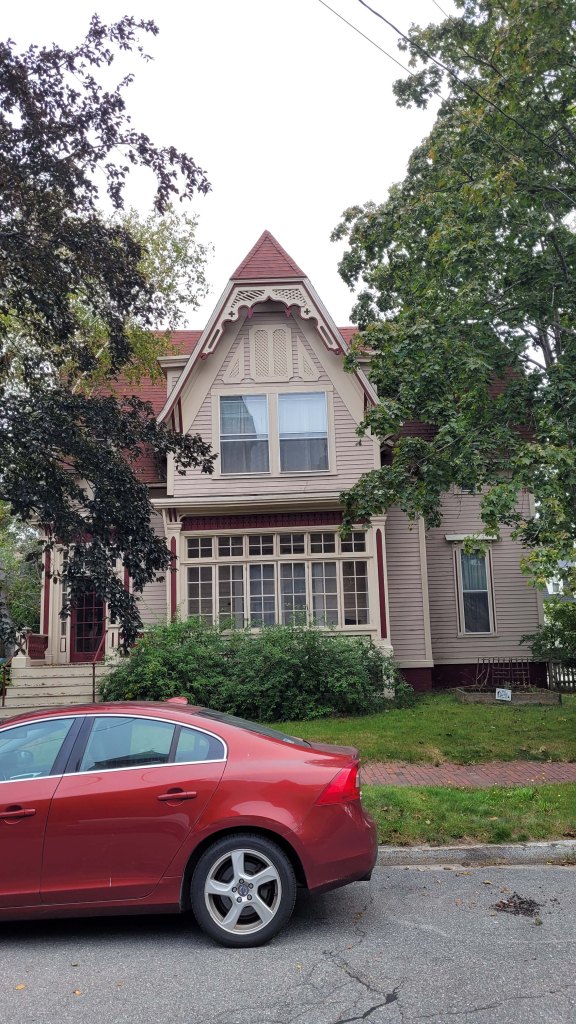
An interesting eclectic home in the West End Historic District.
It must have seemed like their world was ending
Seth Hersey and Frances ‘Fanny’ Woodman married in the summer of 1865. Soon after marrying, they moved into a rented home on the corner of Free and Cross Streets and contemplated starting a family. 1 year later, it all came apart.

Maine Memory Network
The Great Fire of 1866 destroyed much of the old residential and mercantile district of Portland. The Hersey’s home was consumed in the conflagration as was Seth’s place of employment, Woodman & True. If you noticed the Woodman connection, you are correct. Fanny was the ‘boss’ daughter’. More on that in a bit…
In late September of 1866, Seth Hersey purchased a lot on the corner of Thomas and a yet to be named street, now Spruce, from John Bundy, John Marshall & Phillip Brown. The lot was, and still is, .15 acres. Seth paid $2700 for the property. On this lot, Seth and Fannie built a curious structure indeed. It consists of 2 2-story blocks intersecting with each other. All under a very high-peaked roof with clipped gables. The house has long been described as ‘Swiss Style’. I’m not so sure but, we will get to that.

35 Thomas Street in 1924. Maine Memory Network
Seth Hersey was born in Portland in 1832. His parents, Elias & Mary, were Portland natives as well. Elias was veteran of the War of 1812. He was a merchant who dealt in various products with salt, by the ship load, being the primary item. He died in 1837. Mary married Joseph Gerrish, a widower newspaper publisher sometime after 1841 when his first wife died.
Frances Ellen Woodman was also born in Portland in 1838. Her parents, George & Charlotte were from New Gloucester. Frances was their first born. George Woodman was a dry goods merchant who partnered with Edward True to form ‘True & Woodman’, later ‘Woodman & True’, around the time of Frances’ birth.

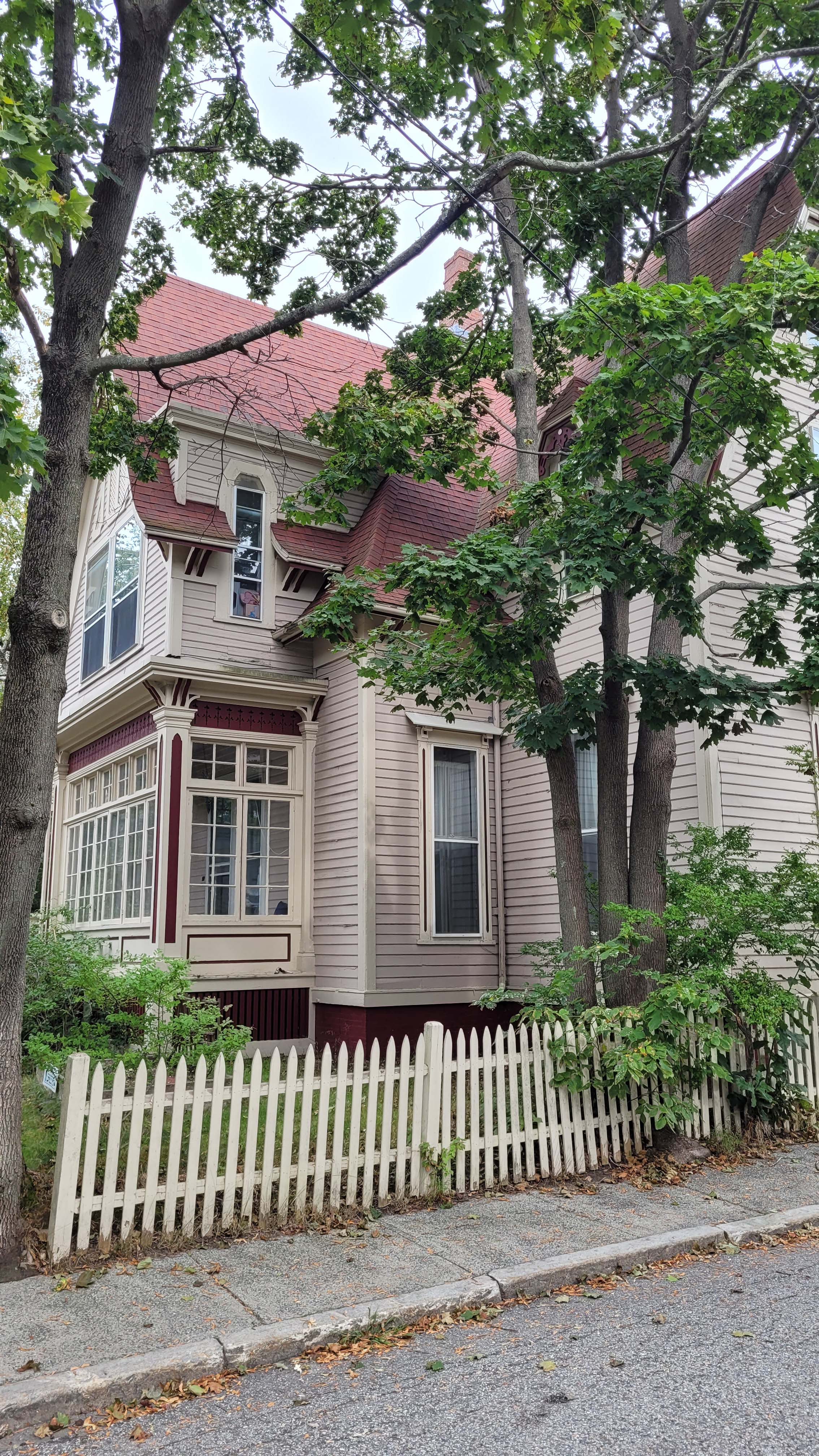
The view from Spruce Street gives a better idea of how the two blocks of the house intersect. The main block, facing Thomas Street, is 43′ wide and 16′ deep. The rear block is 24′ x 24′ with a 10′ x 16′ extension on the north side, facing 41 Thomas Street. This block is capped with a hip roof instead of the gabled roof of the main block. All the roofs have distinctive flared eaves.

Seth Hersey ‘drops out’ of the historical record for the period from Elias’ death in 1837 and 1850. In that year’s census, he was to be found living on Spring Street with his mother, Joseph Gerrish, and his family. They lived on Spring Street between Oak and High Streets. At that time, Seth was working as a bank clerk. When the 1860 census was done, Joseph Gerrish was dead and Mary, Seth, and a domestic servant were living on Middle Street near Hampshire.

35 Thomas Street in 2015
As this is a Redux, it’s worth taking a brief look back to February of 2015 and the very first article. It was part of a look at a few houses here on Thomas Street and the actual mention of #35 was a total of 124 words and 3 photos one of which you see above. There was not much to it.


Seth and Fanny Hersey had 4 children, 2 daughters & 2 sons, between 1869 and 1878. Seth was a mason and long-tine member of the Board of Trade. After the Great Fire, Woodman & True rebuilt further up Middle along with much of the dry goods trade. The firm, of which Seth had become a partner in 1855, hired George Harding to design their new headquarters. He obliged with a grand building in the Second Empire Style that is still a landmark on the street.


About the ‘Swiss Style’. It seems to have been applied when the Portland Historic Resources Inventory was created in 1976. Style attribution is somewhat subjective but, I have to state, I do not see where 35 Thomas Street is in any way ‘Swiss’. Especially when viewed in the context of the late 1860s. What few designs for ‘Swiss’ architecture published in the period did not show anything like our subject. All were variations on a ‘Swiss Chalet’ theme as seen below. Then there is the question of where would the Hersey’s and their architect, assuming there was one and we will look at that, even have gotten ideas for a ‘Swiss Style’ home in conservative Portland Maine.

William Ranlett, 1849. Vintagedesigns.com
If looked at as an eclectic take on the Stick Style, it makes more sense. It’s quite restrained in the use of applied ornament but what is there is well done, It is more expressive of style than structure which does argue a bit against the Stick Style but not enough to not consider it more. The steep roof line is certainly more in line with Stick as are the stylized dormers and brackets.
 Seth Hersey died of peritonitis on December 15, 1894. Fannie died of pneumonia in 1913. She sold 35 Thomas Street to Hiram & Henrietta Cox in 1904. Hiram was born in Dixfield in 1843 and Henrietta in Brunswick in 1844. Hiram They married in DIxfield in 1864. He was a dry goods dealer. They had 3 children, one dying in infancy. They lived next door at #41 and rented our subject. One renter was the Reverend James H Albion, his wife Alice, and their 3 children. James was the Minister of the Congress Square Universalist Church. This church stood where the WCSH building stands.

Congress Square church ca: 1900. Maine Memory Network
Hiram Cox jumped to his death from his third-story hotel room in Hot Springs Arkansas on December 24 of 1908. Newspaper articles stated he had been “in poor health” and “under treatment for his nerves”. Interestingly, Hiram and transferred ownership of 35 Thomas Street to Henrietta in early October of that year. In 1915, she sold it to Elizabeth Flaherty.

Elizabeth and Thomas Flaherty were both born in 1855 and 1873 respectively, in Portland to Irish immigrants. They married in 1899. They had 2 daughters. Robert worked as a clothier in the first years before becoming an insurance agent. He had opened his own office on Exchange Street by 1913.

Portland Sunday Telegram March 23, 1913. Newspapers.Com
Thomas Flaherty died on September 21, 1940 after a prolonged illness. Elizabeth lived on here until she died on December 6, 1956. Her will transferred 35 Thomas Street to her daughters, Margaret & Emily. In January of 1957, they sold it to a banker formerly from Cape Elizabeth named William Derrah. Derrah barely had time to unpack before he died on July 22 of the same year. In 1959, his heirs sold our subject to a couple from Portland who, soon after, sold to a real estate broker from Falmouth named Wallace E Kimball. The current owners purchased it from Kimball in 1971

As 35 Thomas Street saw renters in one, or both, parts of the house, lets look at some of these people.
-
- John & Mary Boober in 1951. John was a buyer for Porteous, Mitchell, & Braun.
- Thomas & Carla Skiffington in 1960. Thomas was a teacher in the Kennebunk school system
- Evelyn, Jane & Maureen Roderick in 1958 & 59. Evelyn was a dental assistant in an office on Bramhall. Jane and Maureen were her daughters. Jane was an office clerk for Edwards & Walker in Monument Square. Maureen was an advertising sales person for a publishing company in the Baxter Block on Monument Square.
- Frank Farrington in 1963. He was a 31 year old Augusta native who was an assistant director at Union Mutual Insurance.
- Allen Glazier in 1963. Glazier was a 30 year old Portland native who worked as a clerk for Union Mutual Insurance.

The garage is a 20th century building
35 Thomas Street is listed as a 3 family home. The condition is good.

 Portland House Stories